
My son can’t see. how do i explain colours to him?
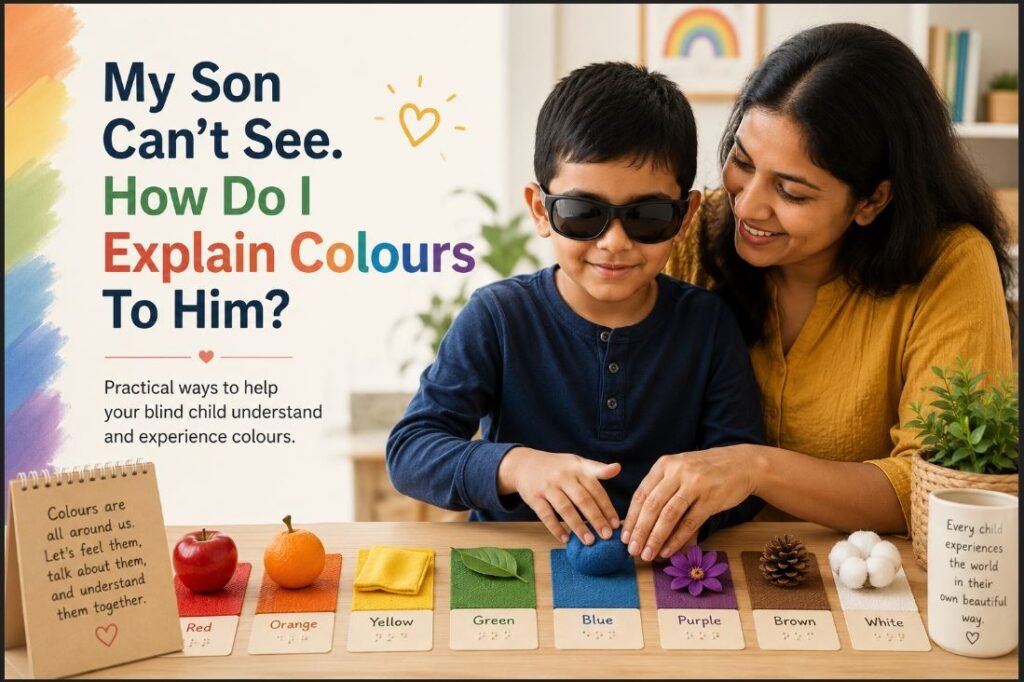
When a parent says, “my son can’t see. how do i explain colours to him?” the question often comes from love, worry, and a deep desire to include their child in a world that talks about colour constantly. We describe red apples, blue skies, green grass, yellow sunshine, white snow, and black night. Colour appears in stories, songs, clothes, school activities, traffic lights, art, food, and emotions. So when your child is blind or visually impaired, it is natural to wonder whether colour is something you should explain at all. The answer is yes – but gently, creatively, and without pressure. A blind child may not experience colour visually, but that does not mean colour has no meaning. Colour can be taught as language, information, association, culture, emotion, temperature, texture, sound, smell, and memory. Your goal is not to make your child “see” red or blue exactly as you do. Your goal is to help him understand how colour works in the world and how people use colour to describe things. Start by talking about colours naturally Do not avoid colour words. Say them in everyday conversation. You might say, “You’re wearing your blue jumper today,” “This banana is yellow,” or “Grandma’s car is silver.” Even if your son cannot see the colour, he can learn that colour is a property of objects, just like shape, size, texture, sound, or smell. This helps him take part in conversations. If someone asks, “What colour is your bag?” he can answer confidently. If a story mentions a red dragon or a green forest, he has a mental category for those descriptions. Colour becomes part of his vocabulary, not a forbidden subject. Explain colour as information One helpful way to answer “how do i explain colours to him” is to treat colours as useful information. For example: Red is often used for danger, heat, love, stop signs, fire engines, and ripe strawberries. Green is often connected with grass, leaves, nature, “go,” freshness, and vegetables. Blue is linked with water, sky, calmness, jeans, and sometimes sadness. Yellow is associated with sunshine, bananas, brightness, happiness, and warning signs. White can mean snow, milk, clouds, cleanliness, or weddings in some cultures. Black may be connected with night, shadows, formal clothes, or mourning in some cultures. This does not mean every colour has one fixed meaning. Colours change meaning depending on culture, context, and personal experience. But these associations give your child a way to understand why people talk about colours so often. Use the senses he already trusts Colour can be explained through touch, taste, smell, sound, and temperature. Red can feel warm, like a mug of hot chocolate, a sunny windowsill, or the beat of a drum. Blue can feel cool, like water, smooth stones, or calm music. Yellow can feel bright and cheerful, like warm sunlight on the skin or the smell of lemons. Green can feel fresh, like grass under bare feet, mint leaves, or the smell after rain. Brown can feel earthy, like tree bark, soil, toast, or cinnamon. White can feel soft and quiet, like cotton, snow, or clean sheets. These comparisons are not perfect, but they help build emotional and sensory bridges. The point is not to say, “Red is heat.” The point is to say, “Many people think of red as warm, strong, and full of energy.” Let him build his own colour meanings Your son may create associations that are different from yours. That is not wrong. In fact, it is beautiful. Maybe he decides blue feels like piano music. Maybe yellow feels like laughter. Maybe green smells like the garden after watering. Maybe purple feels like velvet or sounds like a low cello. Let him own those meanings. Ask questions such as: “What does red make you think of?” “Which colour sounds happiest to you?” “If this song had a colour, what colour would it be?” “What colour do you think this soft blanket should be?” These questions turn colour into imagination rather than a test. Use real objects instead of abstract explanations Children learn best through real experiences. Instead of explaining colours only with words, connect colours to objects your son can touch, smell, taste, or use. In the kitchen, you can talk about yellow bananas, green apples, red tomatoes, orange carrots, brown bread, and white rice. In the garden, you can talk about green leaves, brown soil, red roses, and yellow flowers. During dressing, you can describe the colours of his clothes and explain why some colours are chosen for special occasions. You can also label items with braille or tactile markers if he reads braille or uses touch-based systems. For example, his red cup might have a raised sticker, his blue folder might have a smooth strip, and his green box might have a textured corner. This allows colour words to become organised and practical. Teach colour through stories and emotions Stories are a wonderful way to explain colour. Many children’s books use colours to create mood. A dark forest may feel mysterious. A golden crown may feel royal. A red heart may mean love. A grey sky may suggest rain or sadness. When reading together, pause and explain what the colour is doing in the story. You might say, “The author says the sky is grey because grey often makes people think of cloudy, rainy, quiet days.” Or, “The princess wears purple because purple is often connected with royalty.” This helps your child understand colour as part of storytelling, symbolism, and emotion. Be honest about what cannot be translated It is okay to say, “I cannot fully explain what seeing red looks like, just as I may not fully understand how you recognise people by voice or how you notice tiny changes in sound.” This honesty respects your child. It also shows that everyone experiences the world differently. Sighted people do not have a perfect understanding of everything, and blind people are not missing every kind of knowledge. They simply gather information