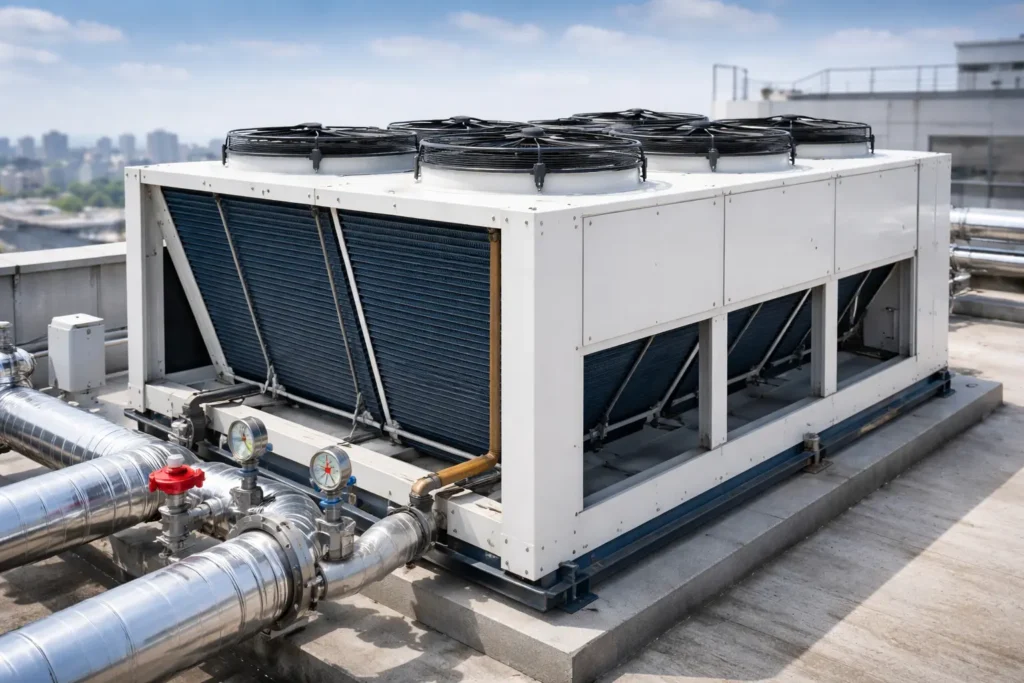

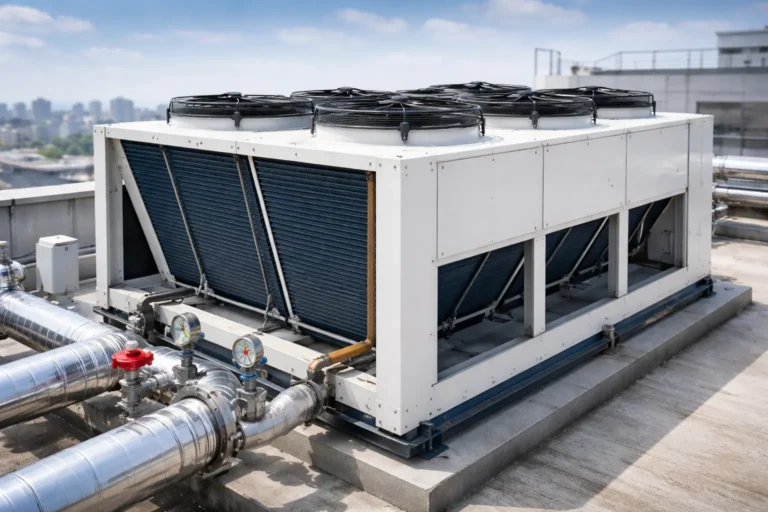
An air cooled chiller transfers heat from a chilled liquid (usually water or water-glycol mix) to the outside air with the help of mechanical fans. Air cooled chillers provide chilled water which is then circulated through buildings’ air handling units, fan coils or process equipment to help achieve precise temperature control.
Unlike standard air conditioners that cool the air directly, air cooled chillers first cool a liquid medium. This chilled liquid travels through the facility doing the work of transporting cooling energy to where it is needed. Capacity and versatility make chillers the premier solution for large multi-zone commercial and industrial facilities.
Air cooled chillers come in self-contained units that sit outside (normally on a rooftop or ground mounted next to the building) which allows for easier installation compared to water cooled chillers which require cooling towers and a separate mechanical room.
How Air Cooled Chillers Work?
Essentially an air cooled chiller contains the same vapor-compression refrigeration cycle found in your kitchen refrigerator. It’s just been magnified many times and designed to operate reliably and efficiently. The refrigeration cycle transfers refrigerant through four basic stages to remove heat from water and exhaust it to the outside air.
Evaporation — Heat Absorption
Hot water returning from the building flows through the evaporator. Heat from the water is absorbed by the refrigerant, which boils and changes from liquid to a low-pressure gas. Cooled water flows from the evaporator ready to circulate cooling through the building.
Compression — Pressure & Temperature Rise
The compressor (sometimes called the heart of the chiller) pulls in refrigerant vapor and increases its pressure many times. As the refrigerant is compressed, its temperature is also increased so that it can expel the absorbed heat to the outside air.
Condensation — Heat Rejection
Superheated refrigerant flows to the condenser coils. Mechanical fans draw ambient air across finned coils which pulls heat from the refrigerant. Refrigerant releases its heat then cools down and condenses back into liquid form. This is where air cooled and water cooled systems differ.
Expansion — Pressure Reduction
Expansion of the liquid through an expansion valve drops its pressure and temperature suddenly. It returns cold to the evaporator to pick up more heat from the building water and the cycle repeats.
“An air cooled chiller is similar to a radiator that cools down an automobile engine – a fan blows air across coils filled with refrigerant to absorb heat.”
Key Components Explained
Knowing what the major parts of an air cooled chiller are can help you with maintenance and purchasing decisions. These parts are built into compact, optimised units with each other on newer models by major manufacturers.
Compressor
The compressor provides energy to drive the refrigeration cycle by compressing the refrigerant. Air cooled chillers typically use screw compressors for medium-to-large capacity units, or scroll compressors for smaller units. Some variable-speed drive (VSD) compressors can adjust output to the real time cooling load requirements, resulting in significant energy savings during part-load conditions, when most of the operating hours are spent.
Air-Cooled Condenser
The condenser is made up of finned coil type heat exchangers that the refrigerant flows through. Fans then pull or push ambient air across those coils. The harder ambient air temperature rises the harder the chiller must work to reject heat.
Evaporator (Chilled Water Heat Exchanger)
The evaporator is usually a shell-and-tube or brazed plate heat exchanger where building return water transfers its heat to the refrigerant. Maintaining cleanliness of the evaporator is essential to maintain system efficiency and avoid freeze-ups.
Expansion Valve
This flow control valve meters refrigerant into the evaporator, causing a reduction in pressure and temperature of the refrigerant. Electronic expansion valves (EEVs) used on many modern chillers allow for much more responsive precise control when compared to older thermostatic expansion valves.
Control System
It’s brain is working overtime, constantly measuring temps, pressures, loads and ambient conditions to fine-tune performance. Chillers today – such as the Aguman certified Chiller Access Manager available on Aguaman® units – allow for remote monitoring, cybersecurity protection and connectivity with building management systems (BMS) to help optimise energy use throughout the entire building.
Read more on Different Types of Chillers – Air Cooled & Water Cooled Chillers Explained
Advantages & Disadvantages of Air Cooled Chillers
Its brain is working overtime analyzing temps, pressures, loads and ambient conditions to optimise performance. Today’s chillers – including Aguman® units with Aguaman® certified Chiller Access Manager – enable remote monitoring, cybersecurity protection and connectivity with building management systems (BMS) to help optimise energy use throughout the building.
Advantages
- Does Not Require a Cooling Tower – Easier Installation
- Low first cost
- No water use or water treatment chemicals
- Installed outdoors, saving valuable indoor space
- Quieter, easier commissioning
- Less maintenance
- Suitable for water-starved applications
Disadvantages
- Lower energy efficiency vs. water cooled systems
- Performance degrades in very hot climates (above 95°F)
- Exposed to weather, reducing longevity vs. indoor units
- Fan noise can be a concern near occupied spaces
- Less suitable for very large cooling loads
- Condenser coils require regular cleaning